
Product data
| Category: | Hantavirus Antibody Test |
| Manufacturer: | parahealth |
| SKU: | RG-RNPT96027-01 |
| EAN: | 6974443201819 |
| Best before: | 31.05.2028 |
| Test method: | Schnelltest (RDT),Point-of-care test |
| Sample type: | Blut |
| IFU languages: | EN |
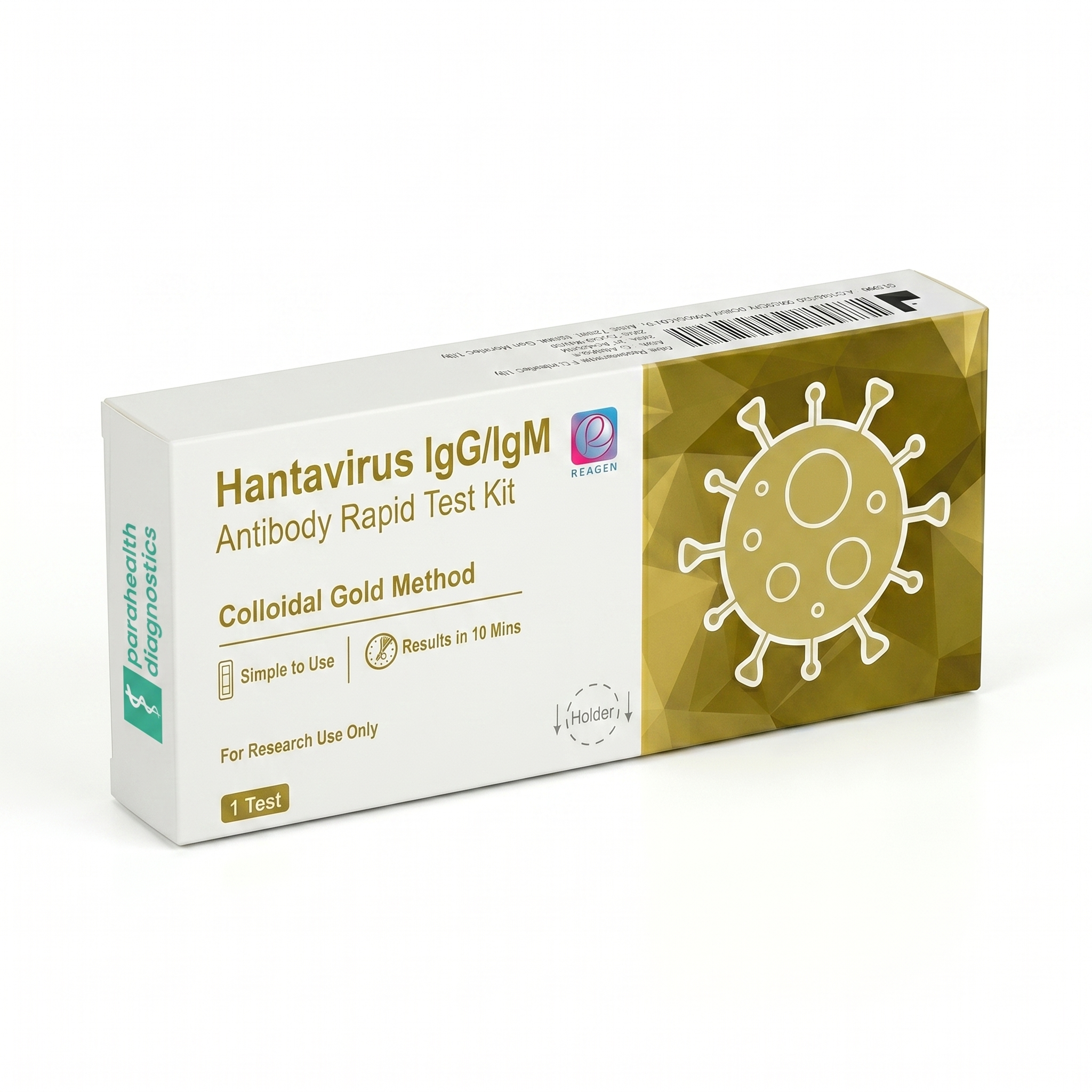
Hantavirus IgG/IgM Antibody Rapid Test Kit
Benefits:
- Result in approx. 10 minutes
- CE certified for professional IVD use
- Multiple sample types
- High sensitivity and specificity
- No laboratory required
Shipping calculated at checkout
Volume Discounts
Volume Discounts
Shop safely
Volume Discounts
Volume Discounts
Description
The first Hantavirus rapid test in the parahealth portfolio. This CE-IVD certified lateral-flow rapid test enables the qualitative point-of-care detection of Hantavirus IgG and IgM antibodies in human whole blood (capillary or venous), serum and plasma. It supports the early differentiation of acute (IgM-positive) and past or convalescent (IgG-positive) Hantavirus infections — a critical step in the differential diagnosis of Hemorrhagic Fever with Renal Syndrome (HFRS) and Hantavirus Pulmonary Syndrome (HPS).
Hantavirus serology has long been the domain of central laboratories — with turnaround times of one to several days. This rapid test brings the immunological signal to the bedside, the outpatient clinic, the emergency department and field investigations within ten minutes, while preserving the IgM/IgG class differentiation that is clinically decisive in the early-phase work-up of suspected hantaviral disease.
Why this Hantavirus Test
- First Hantavirus rapid test in the parahealth catalog — closing a long-standing gap in point-of-care serology.
- Simultaneous, class-separate detection of IgG and IgM antibodies on a single cassette with built-in control line.
- Result in 10 minutes — no laboratory infrastructure or thermal cycler required.
- Compatible with capillary whole blood (fingerstick), venous whole blood, serum and plasma.
- Validated with the common anticoagulants heparin, EDTA and sodium citrate.
- Manufactured under CE-IVD and ISO 13485:2016.
- Shelf life 24 months — current lot best before 05/2028.
- Individually sealed cassette plus complete accessory set including sterile lancets for fingerstick sampling.
Test principle — immunochromatographic antigen-capture
The cassette uses a recombinant Hantavirus-specific antigen as a colored ultra-latex tracer. Two parallel test lines are coated with anti-human IgM and anti-human IgG monoclonal antibodies respectively. When patient antibodies of the corresponding class bind the tracer antigen, the antibody-antigen complex migrates by capillary action along the membrane and is captured at the respective test line (G or M), producing a visible red band. The internal control line (C) confirms correct sample flow and reagent integrity regardless of the analytical result.
Clinical interpretation — IgM vs IgG
- IgM-positive / IgG-negative: Early acute or recent Hantavirus infection — IgM antibodies typically appear within the first few days after symptom onset.
- IgM-positive / IgG-positive: Seroconversion phase or active infection — the patient is mounting both the early and the matured immune response.
- IgM-negative / IgG-positive: Past exposure or convalescence — IgG persists for months to years.
- IgM-negative / IgG-negative: No detectable antibodies. Does not exclude a very early window-phase infection; consider PCR or repeat testing.
Step-by-step procedure
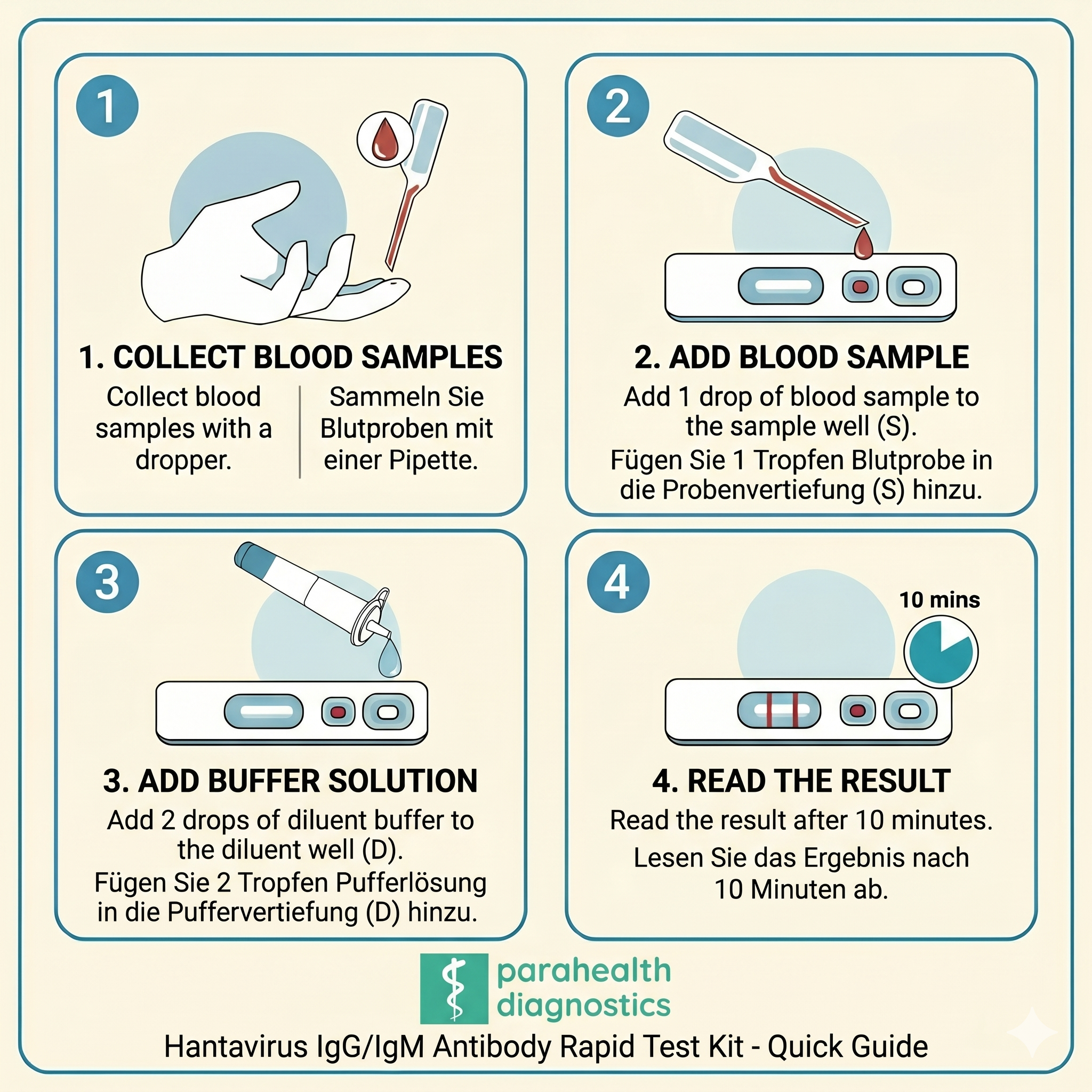
- Equilibrate the sealed test cassette and the sample to room temperature.
- Open the foil pouch and place the cassette on a clean, level surface — use within one hour of opening.
- For whole blood / serum / plasma: aspirate the sample with the disposable dropper and add 1 drop into the sample well (S).
- For fingerstick: disinfect the fingertip with the supplied alcohol pad, prick using the sterile lancet, collect a drop with the dropper, then add 1 drop into well (S).
- Add 2 drops of the sample diluent buffer into the diluent well (D) and start the timer.
- Read the result at 10 minutes. Results read beyond 20 minutes are no longer clinically valid.
Analytical sensitivity, specificity and performance
The kit's analytical sensitivity meets the manufacturer's internal minimum-detection-limit specification — defined as the lowest antibody concentration that consistently yields a positive signal across the validation lots. The two test lines (G and M) operate independently, so IgM and IgG detection are not subject to mutual signal competition.
Diagnostic specificity has been characterised through (a) a curated cross-reactivity panel against ten unrelated pathogens, and (b) an interference panel covering the most relevant whole-blood matrix variables. Both panels are summarised below. As with every serological lateral-flow assay, the final clinical conclusion must combine the rapid-test result with patient history, symptomatology, epidemiological exposure and — when indicated — RT-PCR or laboratory ELISA confirmation.
Cross-reactivity panel
In manufacturer validation studies, the test demonstrated no cross-reactivity with samples containing:
- Measles virus antibodies
- Rubella virus antibodies
- Influenza A virus antibodies
- Salmonella typhoid fever serology
- Leptospirosis serology
- Septicaemia samples
- Epidemic cerebrospinal meningitis samples
- Hepatitis B virus markers
- Hepatitis C virus markers
Note: very high concentrations of rheumatoid factor (RF) or heterophile antibodies can give false-positive reactions on any lateral-flow IgM assay. In suspected RF-positive patients confirm with an orthogonal method.
Interference robustness
Performance is not affected by the following matrix substances at the indicated concentrations:
- Bilirubin up to 20 mg/dL
- Free haemoglobin up to 5 mg/mL
- Triglycerides up to 15 mg/mL
- Heparin up to 200 IU/mL
- EDTA up to 5 mg/mL
- Sodium citrate up to 10 mg/mL
Clinical use cases
- Suspected Hantavirus infection in patients with acute renal failure, oliguria, thrombocytopenia or non-cardiogenic pulmonary oedema.
- Differentiating HFRS / HPS from leptospirosis, dengue, severe influenza and other viral haemorrhagic syndromes.
- Serological screening in occupational medicine — forestry, agriculture, environmental services, pest control and laboratory animal staff.
- Outbreak investigations and household contact tracing in endemic regions, including Puumala foci in Central and Northern Europe and Sin Nombre / Andes virus foci in the Americas.
- Pre-travel and post-exposure assessment for fieldworkers returning from endemic areas.
Sample types, anticoagulants and stability
- Whole blood (fingertip or venous, with anticoagulant): stable up to 3 days at 2–8 °C. Test as soon as possible after collection.
- Serum: collected from venous blood after coagulation; stable 2 weeks at 2–8 °C, longer-term at −20 °C.
- Plasma: light-yellow supernatant from anticoagulated whole blood after resting or centrifugation; stability as for serum.
- Validated anticoagulants: heparin, EDTA, sodium citrate.
- Bring frozen samples back to room temperature before testing.
Sample quality — visual inspection
Before applying the sample, briefly assess its appearance. The following sample characteristics can interfere with line interpretation:
- Strongly icteric samples (visibly yellow) — bilirubin above the validated range.
- Strongly haemolytic samples — free haemoglobin > 9 g/L.
- Chylous (milky / lipaemic) samples.
Specifications
- Format: Lateral-flow cassette with separate IgG and IgM test lines plus control line.
- Method: Immunochromatographic antigen-capture (ultra-latex tracer).
- Sample types: Capillary or venous whole blood, serum, plasma.
- Time to result: 10 minutes (read window ≤ 20 min).
- Storage: 2–30 °C, dry, away from direct sunlight.
- Shelf life: 24 months from manufacture — current lot best before 05/2028.
- Intended use: For Professional Use Only — in-vitro diagnostic medical device.
- Manufacturer reference: RNPT96027-01.
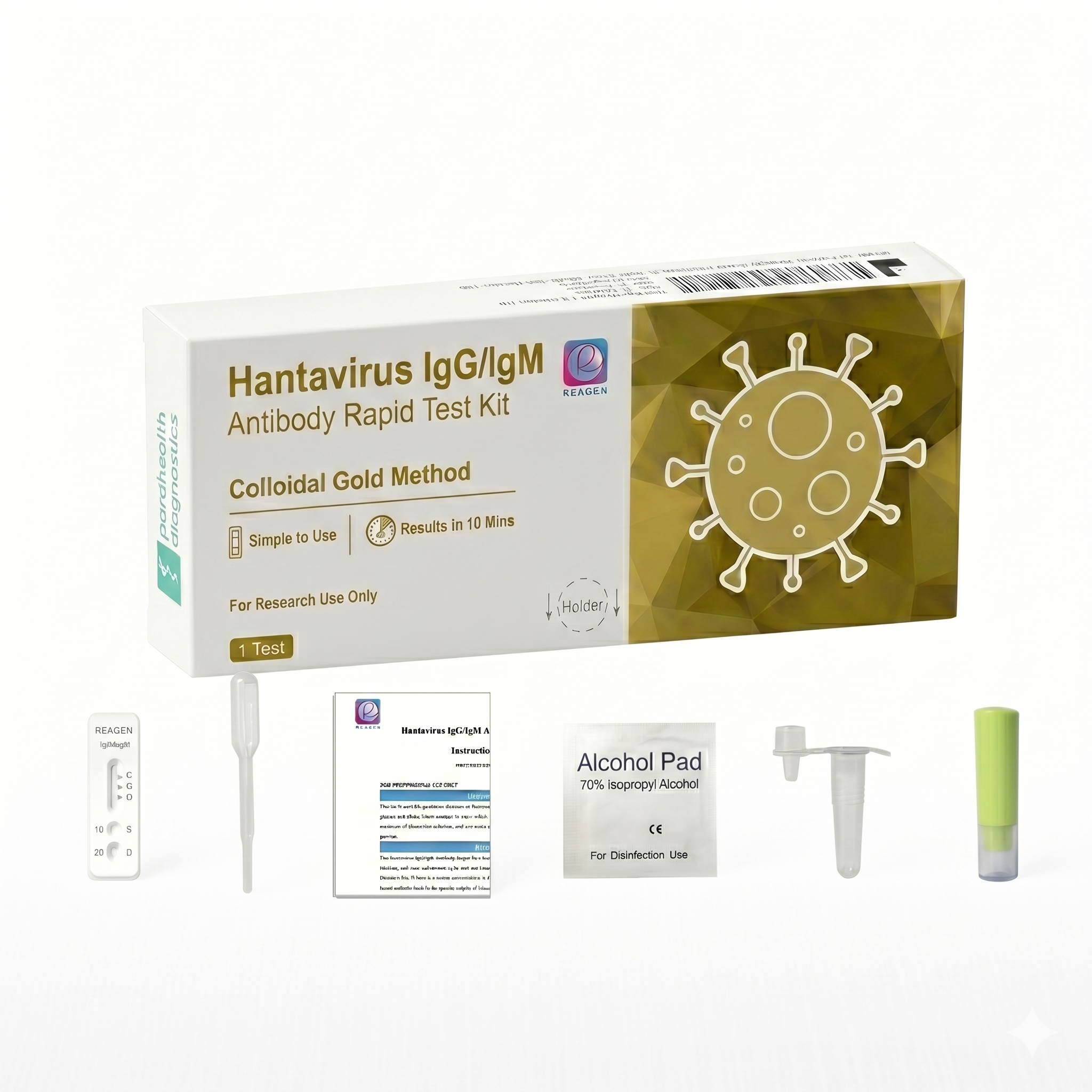
Kit contents (1 test / kit)
- 1× test cassette in foil pouch with desiccant
- 1× sterile lancet
- 1× single-use dropper
- 1× sample diluent buffer
- 1× alcohol pad
- 1× instructions for use
Kit storage — best practice
- Store sealed at 2–30 °C in a dry place, protected from direct sunlight.
- Do not freeze the test cassette.
- Equilibrate cassette and reagents to room temperature before opening to prevent condensation.
- Use opened cassettes within 1 hour; do not reseal.
- Do not mix components from different lots.
Notes and limitations
- Qualitative result only — no antibody titer is reported.
- A negative result does not exclude very early infection where antibody levels are still below the analytical detection limit.
- Very high rheumatoid factor or heterophile antibody titers may produce false-positive lines.
- Final diagnosis remains the responsibility of the treating physician and must integrate clinical findings, exposure history and complementary laboratory testing.
- Single use — do not re-use or use beyond the printed expiry date.
- After use, dispose of cassette, dropper, lancet and buffer container as biomedical waste in accordance with local regulations.
When to choose rapid serology vs. RT-PCR
Hantavirus RT-PCR detects viral RNA and is most sensitive during the very early viremic phase — typically the first days after symptom onset. As the viremia resolves, PCR sensitivity drops while the antibody response (IgM first, then IgG) rises. A combined approach is ideal: PCR for the earliest window, this rapid IgM/IgG test for symptomatic patients beyond the first 3–5 days, and for retrospective seroprevalence in occupational or outbreak settings.
Regulatory status
- CE-IVD — EU authorised representative: CMC Medical Devices & Drugs S.L., Málaga, Spain (SRN ES-AR-000000293).
- ISO 13485:2016 — quality management system certified by SGS UK Ltd (CN21/42019).
- Catalogue references: RNPT96027-01 (1 test / kit), RNPT96027-20 (20 tests / kit).
Background — Hantaviruses, epidemiology and transmission
Hantaviruses are enveloped, single-stranded negative-sense RNA viruses of the family Bunyaviridae. Rodents — voles, field mice and rats — are the natural reservoirs; humans are accidental hosts and acquire infection primarily by inhaling aerosolised rodent urine, droppings or saliva, more rarely through direct bites or contaminated foodstuffs. Sustained human-to-human transmission is essentially restricted to the South American Andes virus.
Clinically the genus splits into two main syndromes. Hemorrhagic Fever with Renal Syndrome (HFRS) dominates in Europe and Asia; in Germany the milder Puumala-induced "nephropathia epidemica" is endemic in the Bavarian Forest, the Swabian Alb and the Münsterland, with several hundred to several thousand notified cases per year. Hantavirus Pulmonary Syndrome (HPS) is largely confined to the Americas (Sin Nombre, Andes), with reported case-fatality rates of up to 38 %. Both syndromes share an acute onset with fever, myalgia and thrombocytopenia, followed by organ-specific complications.
Rapid serological testing for IgM and IgG plays a key role in differential diagnosis alongside RT-PCR — especially when results are needed before central-laboratory turnaround times and when the clinical picture overlaps with other zoonotic or arboviral diseases.
Further professional information
For an in-depth technical and regulatory overview of the Hantavirus rapid test, visit buyhantatest.com.
Manufactured by Shenzhen Reagent Technology Co., Ltd., Shenzhen, China. Manufacturer reference RNPT96027-01. IFU revision A1, release 2025-05-07.
Product data
| Category: | Hantavirus Antibody Test |
| Manufacturer: | parahealth |
| SKU: | RG-RNPT96027-01 |
| EAN: | 6974443201819 |
| Best before: | 31.05.2028 |
| Test method: | Schnelltest (RDT),Point-of-care test |
| Sample type: | Blut |
| IFU languages: | EN |
Data sheets & Downloads
B2B inquiry
Bulk order or reseller?
Invoice payment & account manager.
Pharmacies, practices, clinics, institutions, agencies and businesses: dedicated account manager, custom pricing.
B2B inquiry
Bulk order or reseller?
Invoice payment & account manager.
Pharmacies, practices, clinics, institutions, agencies and businesses: dedicated account manager, custom pricing.
Or email us directly at sales@parahealth.de
Frequently asked questions about parahealth
Find answers to the most common questions about ordering, shipping, and our products.
Are your products clinically tested and safe?
Yes, all our medical devices and diagnostic tests undergo rigorous clinical testing and validation to ensure safety, accuracy, and efficacy. We comply with all relevant medical device regulations and quality standards.
What is your return policy?
We offer a 14-day return policy for private customers. Products must be unused and in original packaging. Please note that B2B and wholesale customers are subject to different terms. Contact our wholesale team for details.
How long does shipping take to Germany?
Standard shipping to Germany takes 1-2 business days from our Berlin facility. We also offer expedited options at checkout for faster delivery.
Do you provide support for professional/clinical use?
Yes, we offer dedicated support for healthcare professionals and clinics, including product training and technical assistance.
What are your B2B payment and shipping terms?
B2B customers receive customized payment terms and shipping arrangements. Please contact our wholesale team for details.
Do you offer bulk orders or wholesale pricing?
Yes, we offer B2B wholesale pricing for pharmacies, clinics, and medical practices. Contact us for volume pricing and terms.
Will I receive tracking information?
Yes, all orders include tracking information sent via email so you can monitor your shipment.
Do you ship internationally?
Yes, we ship worldwide from our Berlin facility. International shipping times vary by destination.
Where do you ship from?
We ship from our state-of-the-art AutoStore Warehouse in Berlin, Germany, ensuring fast and efficient order processing and delivery.