
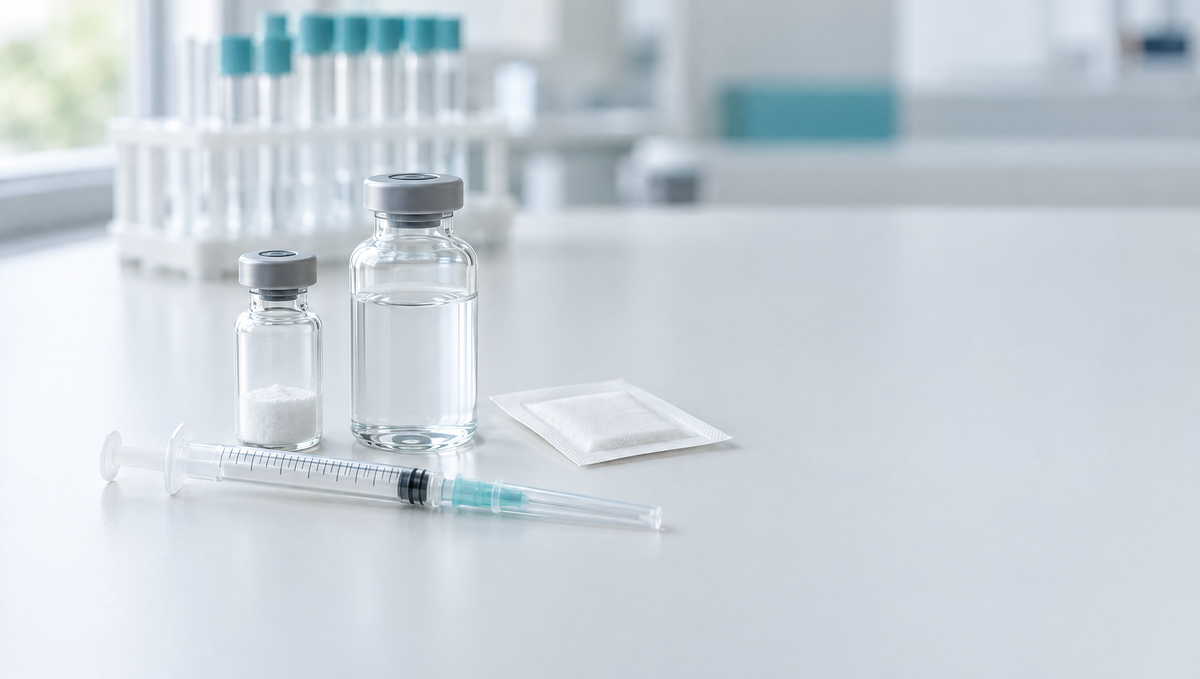
Bacteriostatic water: key takeaways
Bacteriostatic Water for Injection, USP (BAC water), is sterile water for injection with 0.9 percent (9 mg/ml) benzyl alcohol, made for repeated withdrawal from one vial. On a U-100 syringe, one unit marks 0.01 ml. Last reviewed: September 2026.
- The common labeled bottle holds 30 ml (0.9 percent benzyl alcohol); BergdorfBio lists a 10 ml multi-use vial.
- Date an opened multi-dose bottle and discard it within 28 days of first puncture unless the manufacturer states a different date.
- Concentration equals vial content (mg) divided by solvent (ml): 10 mg in 2 ml gives 5 mg/ml, and 2.5 mg then equals 50 units on a U-100 syringe.
- U-100 and U-40 scales differ by the factor 2.5: one unit U-100 marks 0.01 ml, one unit U-40 marks 0.025 ml.
- Shelf life of a mixed peptide solution comes from the drug manufacturer, not from the solvent.
Jump to reconstitution, U-100 units or shelf life. For a full injection walkthrough, see the retatrutide injection guide.
What is bacteriostatic water?
Bacteriostatic Water for Injection, USP (BAC water), is sterile water for injection containing 0.9 percent (9 mg/ml) benzyl alcohol as a bacteriostatic preservative. It is supplied as a multiple-dose container so that one vial can be punctured more than once (Hospira label).
The label limits its purpose to diluting or dissolving drugs for intravenous, intramuscular or subcutaneous injection, as directed by the manufacturer of the drug. The solvent volume follows that instruction.
Bacteriostatic water for injection: benzyl alcohol, pH and bottle sizes
The common 30 ml plastic bottle holds 9 mg benzyl alcohol per milliliter (0.9 percent), while the 20 ml glass fill comes in a 30 ml glass bottle with 1.1 percent (11 mg/ml). The pH is 5.7 (range 4.5 to 7.0).
Because it is preserved, the same vial can be used for several withdrawals. The label also carries the warning "WARNING: NOT FOR USE IN NEONATES". The wording "bacteriostatic" and the stated benzyl alcohol content on the label decide what you have.
Bacteriostatic water vs sterile water and saline
Of the four solvents compared here, only bacteriostatic water and bacteriostatic sodium chloride contain benzyl alcohol and allow repeated withdrawal. Sterile water for injection and 0.9 percent sodium chloride are single-dose containers without preservative.
| Question | Bacteriostatic water | Sterile water | Sodium chloride 0.9% | Bacteriostatic sodium chloride |
|---|---|---|---|---|
| Preservative | 0.9% benzyl alcohol (1.1% in the 20 ml glass fill) | none | none | 0.9% benzyl alcohol |
| Multiple-dose use | yes | no | no | yes |
| After opening | discard 28 days after first puncture (28-day rule) | discard the unused portion | discard the unused portion | same as bacteriostatic water |
Sodium chloride is not automatically preserved: the word "bacteriostatic" on the label decides. With single-dose containers the instruction is "Do not reuse single-dose containers. Discard unused portion." (sterile water label, sodium chloride label).
How much bacteriostatic water per vial?
Labels leave the solvent volume to the drug manufacturer, and in practice the vial content and the amount of BAC water together set the concentration in mg/ml, so 10 mg in 2 ml gives 5 mg/ml. The tables below show how approved products state strength after mixing and which amounts suppliers report.
There is no official solvent volume for research peptides; the amounts below are supplier-reported use, not study doses or agency recommendations. Retatrutide is not approved anywhere as of September 2026, and Lilly plans its FDA filing for the first quarter of 2027 (Lilly Q2 2026 results).
Water amount and concentration by vial size
Concentration (mg/ml) equals vial content (mg) divided by solvent volume (ml). Approved products state the resulting strength on the label, as the tesamorelin example below shows.
| Product | Vial content | Concentration after mixing (label) | Example dose and volume | Use after mixing |
|---|---|---|---|---|
| EGRIFTA WR (tesamorelin) | 11.6 mg | 8 mg/ml per label (after adding 1.3 ml bacteriostatic water) | 1.28 mg = 0.16 ml | reconstituted with bacteriostatic water, use within 7 days at 20 to 25 °C, do not freeze |
Reported use: how much bacteriostatic water per vial. The figures below come from supplier product pages and guides.
| Source | Peptide vial | BAC water | Concentration | 10 units on U-100 equal |
|---|---|---|---|---|
| BergdorfBio product page | 10 mg retatrutide | 2 ml | 5 mg/ml | 0.5 mg |
| Another supplier guide | 5 mg | 2.0 ml | 2.5 mg/ml | 0.25 mg |
| Another supplier guide | 10 mg | 2.0 ml | 5 mg/ml | 0.5 mg |
| Another supplier guide | 12 mg | 2.4 ml | 5 mg/ml | 0.5 mg |
| Another supplier guide | 30 mg | 3.0 ml | 10 mg/ml | 1 mg |
How much bac water for 10 mg retatrutide?
BergdorfBio's product page states that a 10 mg retatrutide vial is mixed with 2 ml of bacteriostatic water (5 mg/ml), where 10 units on a U-100 syringe equal 0.5 mg. The retatrutide research vial is listed in 10, 15, 20, 30 and 50 mg sizes.
For retatrutide-specific mixing steps, see how to reconstitute retatrutide step by step in the dosage guide and the retatrutide hub.
How to reconstitute peptides with bacteriostatic water
Reconstitution is one calculation chain from vial content to concentration, volume and syringe units, and the powder dissolves by gentle swirling, not shaking. You need:
- Peptide vial with the stated content (for example 10 mg).
- Bacteriostatic water (0.9% benzyl alcohol, multiple-dose), unless the drug manufacturer specifies another solvent.
- For example, a 10 ml bottle of bacteriostatic water from BergdorfBio.
- U-100 insulin syringe, new for every injection.
Reconstitution math: from vial size to U-100 units
Concentration (mg/ml) equals vial content (mg) divided by solvent (ml). Volume (ml) equals dose (mg) divided by concentration (mg/ml). Units on a U-100 syringe equal volume (ml) times 100; on a U-40 syringe, volume times 40.
Worked example (a calculation example, not a dose): a vial with 10 mg, 2 ml of solvent, target 2.5 mg. Step 1: 10 mg / 2 ml = 5 mg/ml. Step 2: 2.5 mg / 5 mg/ml = 0.5 ml. Step 3: 0.5 ml x 100 = 50 units on a U-100 syringe. On a U-40 scale the same 0.5 ml reads as 20 units.
| Target amount | Starting point | Volume | Units U-100 | Units U-40 |
|---|---|---|---|---|
| 2.5 mg | 10 mg in 2 ml (5 mg/ml) | 0.5 ml | 50 | 20 |
| 4 mg | 10 mg in 2 ml (5 mg/ml) | 0.8 ml | 80 | 32 |
| 1 mg | 10 mg in 2 ml (5 mg/ml) | 0.2 ml | 20 | 8 |
| 1.28 mg | EGRIFTA WR, label 8 mg/ml | 0.16 ml | 16 | 6.4 |
| 10 units U-40 | any concentration (volume conversion only) | 0.25 ml | 25 | 10 |
For EGRIFTA WR, use the concentration stated on the label (8 mg/ml) rather than recalculating it from the vial content. The largest volume in the table, 0.8 ml (80 units for 4 mg at 5 mg/ml), still fits a 1 ml syringe. The marks on the barrel are syringe units, a volume scale, not international units (IU) of the peptide.
Step-by-step reconstitution
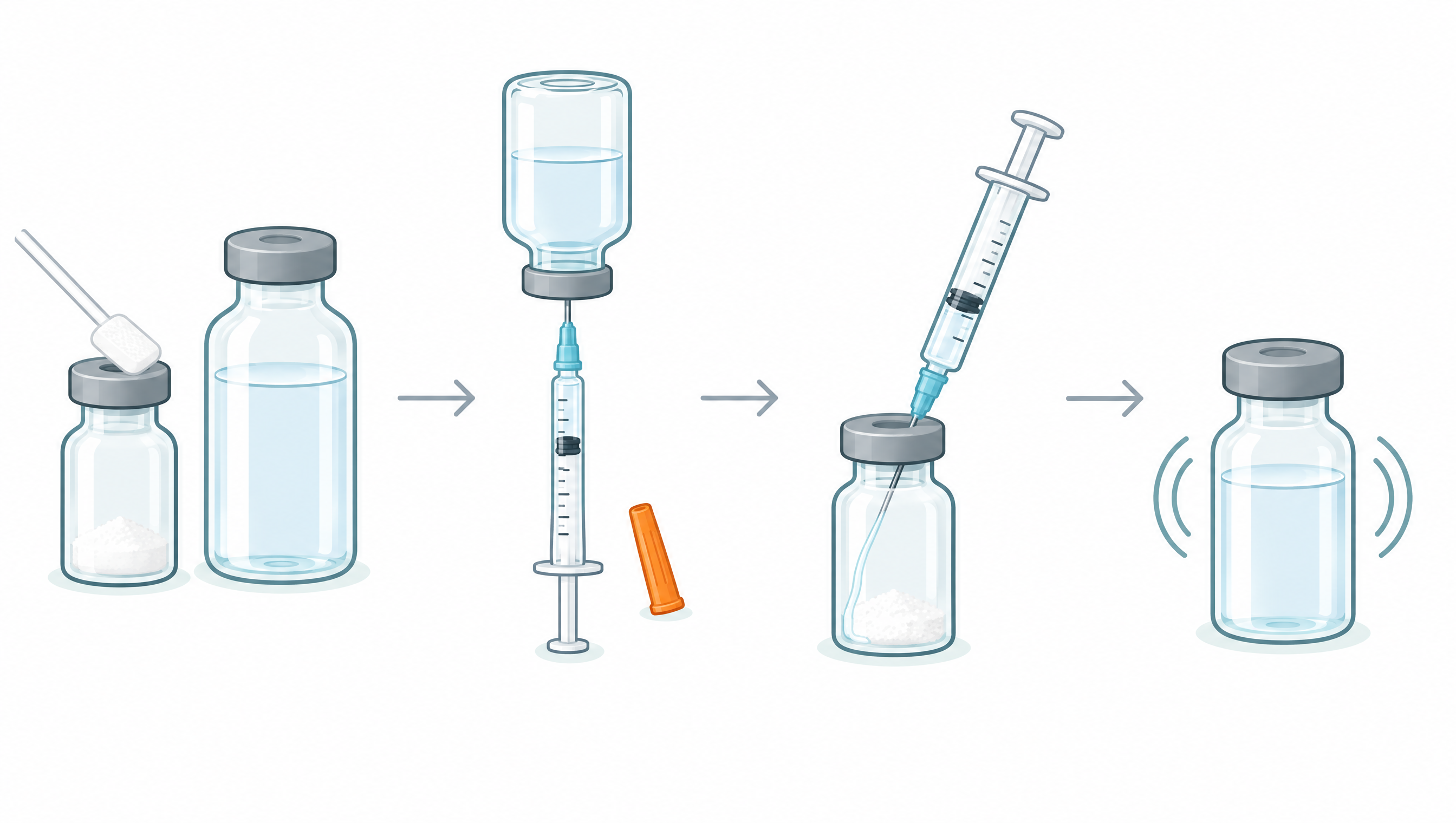
- Calculate concentration, volume and units as shown above.
- Push air equal to the volume you will withdraw (or slightly more) into the bacteriostatic water bottle, then draw the calculated amount of bacteriostatic water into a U-100 syringe. A 1 ml U-100 syringe holds at most 100 units (1 ml), so 2 ml takes two draws.
- Add the solvent to the vial and swirl gently until the powder dissolves. Do not shake.
- Check that the solution is clear and free of particles or discoloration before use.
- Label the vial with date and concentration, and store it as the manufacturer of the drug specifies. Date the opened bacteriostatic water bottle as well (28-day rule).
- Use a new syringe and needle for every injection.
Calculate units with the peptide calculator
The peptide reconstitution calculator covers reconstitution, dose and units on a U-100 syringe. It converts vial size and solvent volume into the volume to draw and the number of units.
Peptide-specific notes: GHK-Cu reconstitution, BPC-157, TB-500 and the Glow stack.
U-100 vs U-40 syringes: how to read units
A U-100 scale marks 100 units per ml (1 unit = 0.01 ml); a U-40 scale marks 40 units per ml (1 unit = 0.025 ml). On peptide solutions the marks are a volume scale only: approved peptide products state strength in mg/ml, not in U-100 units.
U-100 syringe units explained
On a U-100 insulin syringe, 0.3 ml reads as 30 units, 0.5 ml as 50 units and 1 ml as 100 units. Small volumes such as 20 units (0.2 ml) are easier to read on 0.3 ml or 0.5 ml syringes.
Insulin syringes come in 0.3, 0.5 and 1 ml with 6, 8 and 12.7 mm needles; a higher gauge number means a thinner needle, and shorter, thinner needles hurt less (embecta product range; FITTER 2016; FIT UK 2019).
| Feature | U-100 | U-40 |
|---|---|---|
| Units per ml | 100 | 40 |
| Volume per unit | 0.01 ml | 0.025 ml |
| 0.3 ml in units | 30 | 12 (calculated) |
| 0.5 ml in units | 50 | 20 |
| 1 ml in units | 100 | 40 |
| Typical color code | orange needle cap, black scale | red cap, red scale (orientation only) |
| Misreading factor | a U-100 calculation read on a U-40 scale delivers 2.5 times the dose | the reverse delivers 0.4 times |
| Where used | standard US insulin strength | veterinary insulin; both scales in some countries |
The U-40/U-100 mix-up (factor 2.5)
If you read a U-100 calculation on a U-40 scale you deliver 2.5 times the intended amount; the reverse gives 0.4 times. A case report links poorly controlled diabetes to the use of veterinary insulin syringes (Barrera and Murvelashvili 2019).
Color codes are an orientation only: U-40 syringes often have a red cap and red scale, U-100 syringes an orange needle cap and black scale. The print U-40 or U-100 on the barrel decides. Veterinary insulin (Vetsulin) is labeled for U-40 syringes only.
Bacteriostatic water shelf life after opening and storage
Unopened bacteriostatic water is stored at controlled room temperature, 20 to 25 °C. An opened multi-dose bottle is dated and discarded within 28 days of first puncture unless the manufacturer states a different date.
The 28-day rule for multi-dose vials
The CDC recommends dating an opened multi-dose container and discarding it within 28 days of first puncture unless the manufacturer gives a different date. This rule covers the bacteriostatic water bottle itself; it is not a stability statement for a peptide solution you mixed yourself.
The EGRIFTA WR patient information applies the same idea to the solvent: remaining bacteriostatic water in the vial is discarded 28 days after first entry.
Storing reconstituted peptides
Shelf life after mixing comes from the manufacturer of the dissolved drug, not from the solvent. EGRIFTA WR (tesamorelin) is kept at 20 to 25 °C and discarded 7 days after mixing; Novarel (chorionic gonadotropin) is refrigerated at 2 to 8 °C and used within 30 days. BergdorfBio states 28 days at 2 to 8 °C for its retatrutide vial after mixing.
For comparison, the ready-to-use Zepbound single-dose vial (not reconstituted) is discarded after use even if solution remains. Lyophilisate storage is also product-specific: the EGRIFTA WR vial is kept at 20 to 25 °C in the carton, protected from light, so "always refrigerate the powder" is not a general rule. See also the tesamorelin dosing guide.
| Item | Condition | After opening or mixing |
|---|---|---|
| Bacteriostatic water (multi-dose bottle) | unopened: 20 to 25 °C, controlled room temperature | discard 28 days after first puncture unless the manufacturer states otherwise |
| EGRIFTA WR mixed | 20 to 25 °C | discard after 7 days |
| Novarel mixed | 2 to 8 °C | use within 30 days |
| Zepbound single-dose vial (ready-to-use solution, not reconstituted) | 2 to 8 °C, up to 21 days at max. 30 °C | discard after use even if solution remains |
| Retatrutide vial | lyophilized 2 to 8 °C, 24 months | 28 days at 2 to 8 °C after mixing (BergdorfBio product page) |
| Lyophilisate in general | product-specific (EGRIFTA WR at 20 to 25 °C, protected from light) | product-specific |
Is bacteriostatic water safe? Benzyl alcohol and precautions
Bacteriostatic water must not be used in neonates, and it must not be given intravenously without a dissolved substance because that can cause hemolysis. Use it only as the diluent the manufacturer of the drug specifies.
| Event | Condition | Frequency per source |
|---|---|---|
| Benzyl alcohol toxicity | neonates, benzyl alcohol-containing solutions | contraindicated, no frequency stated |
| Blood-pressure changes | intravenous use; estimate from animal data for about 9 ml of 0.9% solution in a 6-kg infant | potentially possible, no frequency stated |
| Hemolysis | intravenous administration without a dissolved substance | label warning, no frequency stated |
| Side effects of subcutaneous 0.9% benzyl alcohol | humans | "not known to occur in man" |
| Lipohypertrophy | repeated injection at the same site | no frequency stated, unreliable absorption |
| Lipodystrophy, local cutaneous amyloidosis | no site rotation | no frequency stated |
| Infection, needlestick injury | reusing syringes, improper disposal | no frequency stated |
The label states that side effects of 0.9 percent benzyl alcohol given subcutaneously are "not known to occur in man". The practical risks of mixing and injecting sit in the technique: repeated injections at the same site can cause lipohypertrophy with unreliable absorption, and reusing needles raises the risk of infection and needlestick injury.
How to inject after reconstitution
With an insulin syringe (shortest needle 6 mm), always lift a skin fold and inject at 90 degrees to it; rotate sites at least 1 cm apart. The steps follow the FITTER 2016 and FIT UK 2019 recommendations, which are written for insulin and applied here to subcutaneous research peptides.
- Push air equal to your dose (or slightly more) into the peptide vial to ease withdrawal, then draw your dose in units on a U-100 syringe.
- Use the shortest available needle (4 mm pen needles, 6 mm syringe needles). With a syringe needle, lift a skin fold; do not press it until the skin turns white.
- Inject at 90 degrees to the surface of the skin fold. FIT UK 2019 does not recommend a 45-degree angle.
- Keep the needle in the skin for at least 5 seconds after pressing the plunger (counting to 10 is better), then withdraw it at the same angle and release the fold.
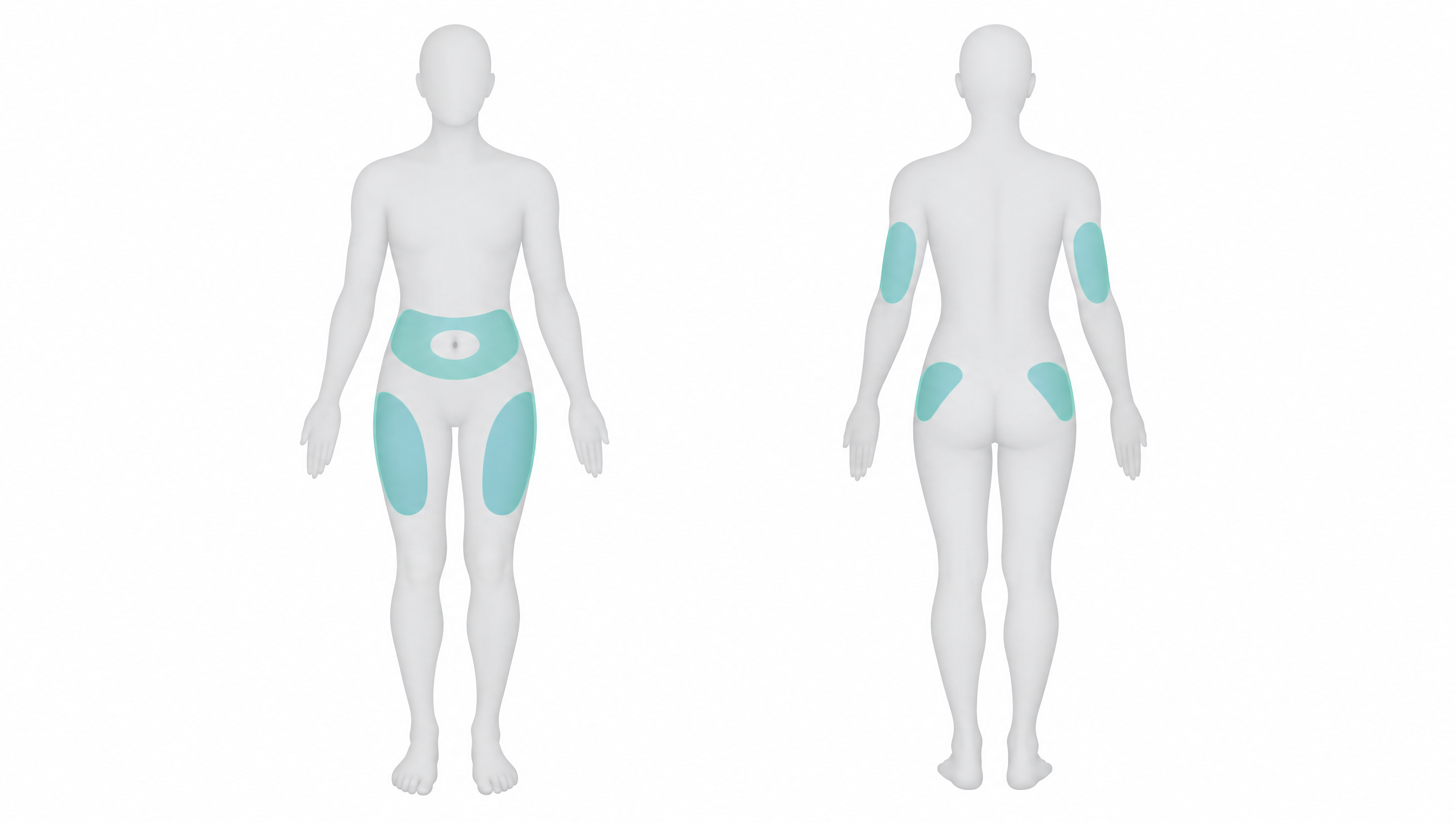
- Rotate sites: abdomen at least 2 cm from the navel (the Zepbound KwikPen instructions state at least 5 cm), upper front and outer thigh, buttocks, and the back of the upper arm if someone else injects.
- Avoid scars, bruises, lipohypertrophy and the navel. If your BMI is under 19, FIT UK advises against syringe needles.
- Use a new syringe and needle for every injection. If there is bleeding, press the site with gauze, do not rub.
- Dispose of needles and syringes immediately in a puncture-proof container and follow local rules (US: FDA sharps guidance).
For a full walkthrough see the retatrutide injection guide. Equipment: injection supplies.
Where to buy bacteriostatic water
Pharmaceutical Bacteriostatic Water for Injection, USP, comes in multiple-dose bottles: for example a 30 ml plastic bottle with 0.9 percent benzyl alcohol or a 20 ml fill in a 30 ml glass bottle with 1.1 percent. BergdorfBio lists a 10 ml multi-use vial with 0.9 percent benzyl alcohol (BergdorfBio 10 ml bacteriostatic water).
Check the label for the word "bacteriostatic", the benzyl alcohol content and the expiry date before you use a bottle. For syringes and needles see U-100 syringes and needles, and for the math see the peptide calculator.
Frequently asked questions
What is bacteriostatic water in simple terms?
It is sterile water for injection with 0.9 percent (9 mg/ml) benzyl alcohol as a preservative, supplied in a multiple-dose vial. The preservative lets you puncture the vial more than once, which is the difference from plain sterile water.
What is the difference between bacteriostatic water and sterile water?
Bacteriostatic water contains 0.9 percent benzyl alcohol and comes in a multiple-dose container, so you can withdraw several times. Sterile water for injection has no preservative and comes in single-dose containers; the instruction is to discard the unused portion immediately.
What is bacteriostatic water used for?
The label limits it to diluting or dissolving drugs for intravenous, intramuscular or subcutaneous injection, as directed by the manufacturer of the drug. The solvent volume follows that instruction, and the pH of the solution is 5.7 (range 4.5 to 7.0).
How much bacteriostatic water do you add to a peptide vial?
There is no fixed amount: the vial content divided by the water volume gives the concentration, and the drug manufacturer's instruction comes first. Supplier examples: 5 mg with 2 ml gives 2.5 mg/ml, 10 mg with 2 ml gives 5 mg/ml, and 30 mg with 3 ml gives 10 mg/ml. More water means a weaker solution and more units per dose on a U-100 syringe.
How do you reconstitute peptides step by step?
Calculate concentration, volume and units first, then add the solvent to the vial and swirl gently until the powder dissolves (do not shake). Check that the solution is clear and free of particles, label the vial with date and concentration, and use a new syringe for every injection.
How many units are 0.5 ml on a U-100 syringe?
0.5 ml reads as 50 units on a U-100 scale and as 20 units on a U-40 scale. One unit marks 0.01 ml on U-100 and 0.025 ml on U-40, so the same volume shows different numbers on the two scales.
What happens if you mix up U-40 and U-100 syringes?
A U-100 calculation read on a U-40 scale delivers 2.5 times the intended amount, and the reverse delivers 0.4 times. Check the print on the barrel (U-40 or U-100); color codes such as a red cap are only an orientation.
How long is bacteriostatic water good after opening?
Date the opened bottle and discard it within 28 days of first puncture unless the manufacturer states a different date. The EGRIFTA WR patient information says the same for remaining bacteriostatic water in the vial. Unopened, the bottle is stored at 20 to 25 °C.
How long does reconstituted peptide last in the fridge?
There is no general rule: labels differ. EGRIFTA WR is kept at 20 to 25 °C and discarded 7 days after mixing, Novarel at 2 to 8 °C within 30 days, and BergdorfBio states 28 days at 2 to 8 °C for its retatrutide vial.
Is bacteriostatic water safe, and can it be used in newborns?
It must not be used in neonates, and it must not be given intravenously without a dissolved substance because that can cause hemolysis. Side effects from 0.9 percent benzyl alcohol given subcutaneously are not known to occur in humans.
Where can I buy bacteriostatic water?
Labeled products come as multiple-dose bottles: for example a 30 ml plastic bottle with 0.9 percent benzyl alcohol or a 20 ml fill in a 30 ml glass bottle with 1.1 percent. BergdorfBio lists a 10 ml multi-use vial with 0.9 percent benzyl alcohol. Check the label for "bacteriostatic", the benzyl alcohol content and the expiry date.
Is bacteriostatic saline the same as bacteriostatic water?
No. Bacteriostatic 0.9 percent sodium chloride contains 9 mg/ml sodium chloride plus 0.9 percent benzyl alcohol and allows repeated withdrawal. Plain 0.9 percent sodium chloride is unpreserved and single-dose unless the label says bacteriostatic. Bacteriostatic water contains no sodium chloride, so the two are not interchangeable: use the diluent that the drug manufacturer specifies.
Sources
- Hospira, Inc. (Pfizer): Bacteriostatic Water for Injection, USP (label, DailyMed). 2019.
- Hospira, Inc. (Pfizer): Sterile Water for Injection, USP (label, DailyMed). 2026.
- HF Acquisition Co LLC (HealthFirst), Hospira: 0.9% Sodium Chloride Injection, USP (label, DailyMed). 2018.
- Hospira, Inc. (Pfizer): Bacteriostatic 0.9% Sodium Chloride Injection, USP (label, DailyMed). 2019.
- Centers for Disease Control and Prevention: Preventing Unsafe Injection Practices (Injection Safety). 2024.
- Theratechnologies Inc.: EGRIFTA WR (tesamorelin) Prescribing Information and Instructions for Use (DailyMed). 2025.
- Ferring Pharmaceuticals Inc.: NOVAREL (chorionic gonadotropin) Prescribing Information (DailyMed). 2023.
- Barrera F, Murvelashvili N: Poorly Controlled Type 3c Diabetes due to Use of Veterinarian Insulin Syringes. Case Reports in Endocrinology 2019.
- Merck Animal Health (Intervet Inc.): Vetsulin Package Insert (DailyMed). 2026.
- embecta: Insulin Syringes with Ultra-Fine needle (product range page).
- Frid AH, Kreugel G, Grassi G, et al.: New Insulin Delivery Recommendations (FITTER). Mayo Clinic Proceedings 2016.
- Forum for Injection Technique (FIT) UK: The UK Injection and Infusion Technique Recommendations, 5th edition. 2019.
- Eli Lilly and Company: Instructions for Use ZEPBOUND (tirzepatide) single-dose vial. 2026.
- Eli Lilly and Company: Instructions for Use ZEPBOUND (tirzepatide) KwikPen. 2026.
- U.S. Food and Drug Administration: Best Way to Get Rid of Used Needles and Other Sharps. 2023.
- Bergdorf Bioscience: Retatrutide product page (Research Use Only). 2026.
- Eli Lilly and Company: Lilly reports second-quarter 2026 financial results (Form 8-K, Exhibit 99.1). 2026.

Leave a comment
All comments are moderated before being published.
This site is protected by hCaptcha and the hCaptcha Privacy Policy and Terms of Service apply.