
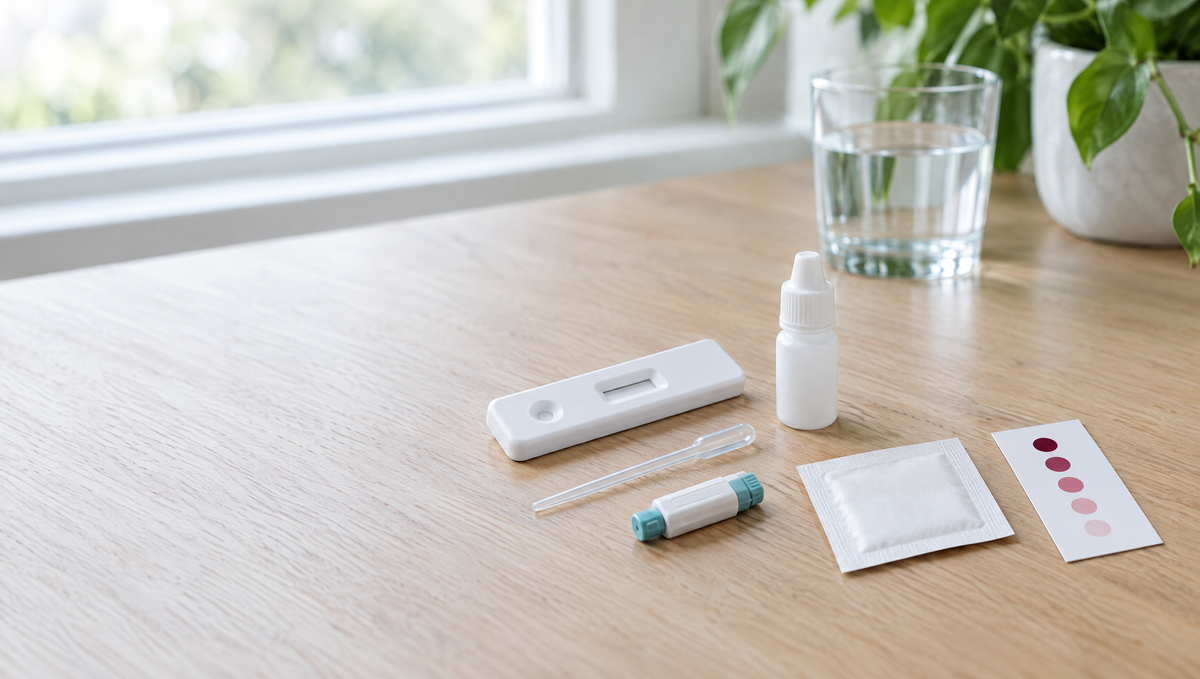
A vitamin D test at home with the parahealth diagnostics Vitamin D Rapid Test estimates 25-hydroxyvitamin D from a drop of fingertip blood. After 10 minutes you read one of four color-card stages; the test gives no exact laboratory value, according to its instructions for use. This guide covers the procedure, reading the color card, official reference values and when to see a doctor. parahealth sells this test. Last updated: September 29, 2026.
Key takeaways
- It measures 25-hydroxyvitamin D (25(OH)D), the storage form of vitamin D.
- The result is semi-quantitative: four color-card stages plus "invalid", read after 10 minutes.
- A lighter test line means more vitamin D; no T line means "excess".
- Test at any time of day; never read after 20 minutes.
- See a doctor for "deficient" or "insufficient", no T line ("excess") or repeatedly abnormal results; only a lab value confirms.
What does an at-home vitamin D test measure?
An at-home vitamin D test measures 25-hydroxyvitamin D (25(OH)D), the main storage form of vitamin D in your blood; according to the German Federal Institute for Risk Assessment (BfR), total 25(OH)D is the suitable marker of your vitamin D status. The parahealth diagnostics Vitamin D Rapid Test is semi-quantitative: after 10 minutes it places your level in one of four color-card ranges, such as 10 to 30 ng/mL (25 to 75 nmol/L), instead of giving an exact number.
Vitamin D3 is formed in your skin under UV light, while vitamin D2 comes mainly from food, and your liver converts both into 25(OH)D, as the instructions for use explain. 25(OH)D has a fairly long circulating half-life of about 15 days, according to the NIH Office of Dietary Supplements.
Rapid test, mail-in lab kit or doctor's test: what is the difference?
A rapid test at home sorts one drop of capillary fingerstick blood into a stage that you read at 10 minutes. A mail-in lab kit or a doctor's test reports a numerical 25(OH)D value; the standard lab test uses blood from a vein, according to MedlinePlus. The instructions for use describe this test as semi-quantitative: a confirmed result requires a second analytical method.
LC-MS/MS (liquid chromatography with tandem mass spectrometry) is regarded as the current gold standard for 25(OH)D measurement. Laboratory methods also differ from one another, as explained in the accuracy section below.
Rapid tests for vitamin D exist in several formats; this one is read visually against a color card. Use it for a first indication at home, and a laboratory value when a number is needed for a medical decision. Discuss a confirmed result with a doctor.
| Criterion | Rapid test at home | Mail-in lab kit | Doctor's office |
|---|---|---|---|
| Sample | Capillary whole blood from the fingertip | Blood sample sent to a laboratory | Usually venous blood drawn at the doctor's office |
| Result | One of four color-card stages, semi-quantitative | A numerical 25(OH)D value | A numerical 25(OH)D value |
| Time to result | Read at 10 minutes | Set by the laboratory | Set by the laboratory |
| Method and reference | Competitive chromatographic immunoassay, evaluated against another rapid test | Laboratory method; LC-MS/MS is the reference method | Laboratory method; LC-MS/MS is the reference method |
| When it is useful | First indication at home | When an exact value is needed | When an exact value and further analysis are needed |

Who should consider a vitamin D test?
The German Nutrition Society (DGE) recommends measuring your vitamin D status only when a deficiency is reasonably suspected or in people at risk, and the Endocrine Society advises against routine 25(OH)D testing without an established indication. In standardized German survey data from 2008 to 2011, about 15% of adults were below 30 nmol/L (12 ng/mL) and about 44% reached 50 nmol/L (20 ng/mL) or more, according to the BfR; these shares vary strongly with the season.
Risk groups include people who rarely get sunlight on their skin or go outdoors fully covered, people with dark skin, older adults and infants, according to the BfR and the DGE. The Robert Koch Institute (RKI) adds chronic gastrointestinal, liver or kidney disease and medicines that impair vitamin D metabolism, such as anti-epileptics or cytostatics.
MedlinePlus lists further reasons for a test: conditions that make nutrient absorption difficult, such as Crohn's disease, ulcerative colitis or celiac disease, weight-loss (bariatric) surgery, and very little sun exposure. The USPSTF concludes that evidence is insufficient to assess benefits and harms of screening asymptomatic adults (I statement).
The IGeL-Monitor rates the benefit of screening adults without symptoms as "unclear" and notes that screening can produce false results and overdiagnosis. If one of these risk factors applies to you, you can compare options in prevention and metabolism tests.
When is the best time to test?
You can run the test at any time of day, according to the instructions for use, and MedlinePlus says a vitamin D blood test needs no special preparation. The season matters more than the hour: according to the DGE, sunlight in Germany from October to March is not strong enough for adequate vitamin D production in the skin.
In a European study, modeled 25(OH)D3 levels reached their minimum around January 20 and their maximum around July 21. In standardized European data, 17.7% of participants were below 30 nmol/L (12 ng/mL) in the extended winter from October to March, compared with 8.3% in summer.

If you take vitamin D supplements or medicines, do not stop them on your own; tell your doctor about everything you take, as MedlinePlus advises.
How often should you test?
There is no recommended fixed testing interval: the DGE and the Endocrine Society advise against routine testing in healthy people, and follow-up tests are a medical decision, for example during treatment of a confirmed deficiency or when higher doses are prescribed. See the FAQ on how often to test below.
What's in the kit and what else you need
The package of the parahealth diagnostics Vitamin D Rapid Test contains one test cassette, buffer solution, safety lancets, an alcohol pad, a capillary dropper, the color card and the instructions for use. You also need a timer for the 10-minute reading time: the instructions for use list it as required but not included.
Store the sealed pouch at 2–30 °C (36–86 °F) and never freeze it. Do not use a test whose foil pouch is damaged or already open, and run the test within one hour of opening the pouch. Each cassette is for single use: do not dismantle it or touch the test window.
| Component | What it is used for |
|---|---|
| Test cassette | Holds the test window where the C and T lines appear |
| Buffer solution | Added after the blood has soaked in: 2 drops go into the buffer well (B) |
| Lancet | Produces the drop of blood at the fingertip |
| Alcohol pad | Cleans the fingertip before the puncture |
| Capillary dropper | Collects the blood up to the marked line and transfers it to the specimen well (S) |
| Color card | Reference shades for reading the test line at 10 minutes |
| Instructions for use | Describe the procedure, the result stages and the limits |

How do you do a vitamin D finger-prick test? Step by step
According to the instructions for use, the test takes 10 steps: wash your hands, bring the pouch to room temperature, clean and prick your middle or ring finger, fill the dropper to the marked line, release the blood into the specimen well (S), add 2 drops of buffer to the buffer well (B) and read the result at 10 minutes.
Prepare the test
Work on a clean, level surface and keep the cassette dry. Let the sealed pouch reach room temperature before you open it, then run the test within one hour, ideally right away.
- Wash your hands with soap and rinse them with clear warm water.
- Bring the pouch to room temperature, open it, place the cassette on a clean, level surface and lay the dropper, buffer bottle, lancet and alcohol pad next to it.
Take a blood sample
Do not touch the puncture site, and massage your hand toward the fingertip. If the blood does not reach the marked line of the dropper, massage the finger again until it does.
- Pull the cap off the lancet and discard it.
- Clean the fingertip of your middle or ring finger with the alcohol pad and let it air-dry.
- Press the uncapped end of the lancet against your fingertip; the tip retracts automatically after use.
- Keep your hand pointing down and massage the finger toward the tip until a drop of blood forms.
- Touch the dropper to the drop without squeezing the bulb until the blood reaches the marked line, and avoid air bubbles.


Add blood and buffer
Follow the order in the instructions for use: the blood goes into the specimen well (S) first, and the buffer follows into the separate buffer well (B). Fewer than 2 or more than 3 buffer drops can distort the result.
- Release the blood into the specimen well (S) by squeezing the dropper bulb.
- Wait until the blood has completely soaked in, then add 2 drops of buffer into the buffer well (B) and start your timer.

Wait and read the result
Read the result at 10 minutes, as in step 10 below, and take a photo of the cassette next to the color card. Then dispose of the cassette and the lancet according to local regulations and keep everything away from children.
- Wait for the colored line(s) and read the result at 10 minutes by comparing the T line with the color card; do not interpret it after 20 minutes.

How do you read your vitamin D test result?
Compare the test line (T) with the color card 10 minutes after adding the buffer: the lighter the T line, the higher your vitamin D level, and the control line (C) must appear for the result to count. Without a C line the test is invalid and you repeat it with a new cassette.
Why a lighter test line means more vitamin D
In this competitive immunoassay, 25(OH)D from your blood competes with the antigen on the test line for a limited amount of antibody, so the more 25(OH)D in your blood, the lighter the test line becomes, according to the instructions for use. The control line (C) confirms that enough sample was added and that the test ran correctly. Use only the color card from the same package, because cards from different batches must not be interchanged.
The five possible results
Five patterns can appear on the cassette. "Deficient", "insufficient" and "sufficient" show both a C line and a T line of different intensity, "excess" shows the C line without any T line, and "invalid" shows no C line at all. The "excess" stage means a level above 100 ng/mL (250 nmol/L) that may be too high, so the instructions for use advise consulting a doctor.
The ranges behind the stages come from the color card of the test, not from an official guideline. An invalid result is repeated with a new test; if the pattern repeats, stop using the product and contact the seller. Only a laboratory value turns a stage into a number.
| What you see | Category | ng/mL | nmol/L | What to do |
|---|---|---|---|---|
| C and T line, T equal to or darker than the 10 ng/mL field | deficient | 0 to 10 | 0 to 25 | See a doctor and show the result |
| C and T line, T between the 10 and 30 ng/mL fields | insufficient | 10 to 30 | 25 to 75 | See a doctor and show the result; the doctor decides whether a laboratory value is needed |
| C line and a faint T line, equal to or lighter than the 30 ng/mL field | sufficient | 30 to 100 | 75 to 250 | No action based on the test alone; see a doctor if symptoms persist, as the test cannot rule out a level that is too high |
| Only the C line, no T line | excess | above 100 | above 250 | See a doctor |
| No C line | invalid | no value | no value | Repeat with a new test |
Common mistakes and how to avoid them
The table lists the most frequent errors. Too little blood can make the result wrong, and if the control line is missing, the test is invalid; rare false results are possible with immunological tests, so discuss repeated abnormal findings with a doctor.
| Problem | What it does to the result | What to do |
|---|---|---|
| No control line | The result is invalid | Repeat with a new test; if it persists, stop using the product and contact the seller |
| Blood does not reach the marked line | Too little sample, the C line may be missing | Massage the finger toward the tip and fill the dropper again |
| Air bubbles in the dropper | The instructions for use say to avoid them | Fill the dropper by touching it to the drop without squeezing the bulb |
| Result read after 20 minutes | The result is not reliable | Read at 10 minutes; if you missed the time, repeat the test |
| Fewer than 2 or more than 3 buffer drops | The result can be distorted | Apply exactly 2 drops into the buffer well (B) |
| Cassette got wet | The result can be wrong | Use a new test from an undamaged pouch |
| Color card from another package | The comparison is not valid | Compare only with the card from the same package |
What does your result mean? Color card vs. official reference values
The color card uses its own stages (0 to 10, 10 to 30, 30 to 100 and above 100 ng/mL), which do not match the official cut-offs of the DGE, BfR, RKI and NIH Office of Dietary Supplements shown in the table. A laboratory value clarifies borderline cases.
| 25(OH)D ng/mL | nmol/L | Official classification (DGE, BfR, RKI, NIH ODS) | Endocrine Society 2011 (retired) | Color card of the test |
|---|---|---|---|---|
| below 10 | below 25 | Risk of deficiency (below 12 ng/mL) | Deficiency (below 20 ng/mL) | deficient |
| 10 to 12 | 25 to 30 | Risk of deficiency | Deficiency (below 20 ng/mL) | insufficient |
| 12 to 20 | 30 to 50 | Generally inadequate, suboptimal | Deficiency (below 20 ng/mL) | insufficient |
| 20 to 30 | 50 to 75 | Adequate for bone health | Insufficiency up to 29 ng/mL | insufficient |
| 30 to 50 | 75 to 125 | Adequate | Sufficiency from 30 ng/mL | sufficient |
| 50 to 100 | 125 to 250 | Potential adverse effects above 50 ng/mL (NIH ODS) | Upper limit 100 ng/mL | sufficient |
| above 100 | above 250 | Toxicity typically above 150 ng/mL with marked hypercalcemia (NIH ODS) | Concern above 150 ng/mL | excess |
The 2011 Endocrine Society guideline was retired and replaced in 2024, and the 2024 guideline found no clear evidence defining an optimal 25(OH)D target level for disease prevention. According to the NIH Office of Dietary Supplements, optimal serum concentrations for bone and general health have not been established.
What vitamin D level is considered deficient?
According to the DGE, the BfR and the NIH Office of Dietary Supplements, the risk of vitamin D deficiency starts below 30 nmol/L (12 ng/mL) of 25(OH)D. The range from 30 to 50 nmol/L (12 to 20 ng/mL) is rated suboptimal by the BfR, and from 50 nmol/L (20 ng/mL) upward supply is generally adequate for bone health.
Laboratories use different cut-offs: some call everything below 75 nmol/L (30 ng/mL) an undersupply, others only values below 50 nmol/L (20 ng/mL), as the BfR notes. In the long term, a deficiency raises the risk of osteomalacia and rickets, according to the BfR. Since 2024 the Endocrine Society has recommended no specific 25(OH)D value for defining vitamin D status, as the BfR notes, and the USPSTF states that no single cut-point defines deficiency.
Does "insufficient" on the color card mean you are deficient?
Not necessarily: the color card's "insufficient" stage covers 10 to 30 ng/mL (25 to 75 nmol/L), and the range from 20 to 30 ng/mL (50 to 75 nmol/L) is already rated as adequate for bone health by the DGE and the BfR. In the other direction, the "sufficient" stage reaches up to 100 ng/mL (250 nmol/L), which includes values above 50 ng/mL (125 nmol/L) where the NIH notes potential adverse effects.
An "insufficient" result is therefore a reason to have an exact laboratory value measured, not proof of a deficiency. The same applies to "sufficient": it does not rule out a level that is too high, and the instructions for use state that the test cannot exclude vitamin D toxicity. Compare the ranges in the table above and discuss the finding with a doctor.
What vitamin D level is too high?
The NIH Office of Dietary Supplements links 25(OH)D above 125 nmol/L (50 ng/mL) with potential adverse effects, particularly above 150 nmol/L (60 ng/mL), and vitamin D toxicity typically involves levels above 375 nmol/L (150 ng/mL) together with marked hypercalcemia. On the rapid test, a missing T line means the "excess" stage, and the instructions for use advise consulting a doctor.
An overdose is not possible through sunlight or your own production in the skin, only through excessive oral intake, as the BfR explains. Signs of too much calcium in the blood include tiredness, muscle weakness, nausea, heart rhythm disorders and weight loss; MedlinePlus lists poor appetite and constipation as further signs of too much vitamin D from supplements. If a doctor has prescribed higher doses, the BfR advises regular checks of the serum level.
Converting ng/mL and nmol/L
1 ng/mL equals 2.5 nmol/L, according to the NIH Office of Dietary Supplements: multiply ng/mL by 2.5 to get nmol/L, or multiply nmol/L by 0.4 to get ng/mL.
| ng/mL | nmol/L |
|---|---|
| 10 | 25 |
| 12 | 30 |
| 20 | 50 |
| 30 | 75 |
| 50 | 125 |
| 100 | 250 |
| 150 | 375 |
How accurate is an at-home vitamin D test?
In the manufacturer's in-house evaluation described in its instructions for use, the parahealth diagnostics Vitamin D Rapid Test placed 85 of 90 whole-blood samples (94.4%) in the same category as another vitamin D rapid test. That comparison was not LC-MS/MS, the laboratory reference method, so the figure describes agreement between two rapid tests, not closeness to an exact lab value.
Only 4 of the 90 samples were classified as "deficient" by the comparison test, so the result for that stage rests on a very small number. The test is semi-quantitative: a confirmed result requires a second analytical method, and results have to be read together with other clinical information.
| Category | Agreement |
|---|---|
| deficient | 4/4 |
| insufficient | 53/56 (94.6%) |
| sufficient | 28/30 (93.3%) |
| all samples | 85/90 (94.4%) |
Laboratory methods are not a fixed yardstick either. In an international standardization comparison, only 50% of ligand-binding assays met the criterion of a mean bias within 5%, and most underestimated 25(OH)D2. Routine immunoassays can deviate from isotope dilution LC-MS/MS depending on vitamin D-binding protein, and variability remains high, especially at low concentrations, where a deficiency can be misclassified.
Capillary whole blood is not identical to serum: in a laboratory study of 44 volunteers, values from capillary dried blood spots agreed well with plasma after a hematocrit-dependent conversion. For background, see how reliable rapid tests are and what sensitivity and specificity mean in medical testing.
When should you see a doctor?
See a doctor and show a photo of the result taken at 10 minutes when the result is "deficient" or "insufficient" (below 30 ng/mL, that is below 75 nmol/L), when no T line appears ("excess") or when your results are repeatedly abnormal, as the instructions for use recommend. The doctor decides whether a laboratory value from venous blood or further analysis is needed, because the rapid test only gives a preliminary stage. Do not start or change vitamin D supplements on the basis of the test alone: the DGE recommends them only when an inadequate supply has been confirmed and cannot be improved through food or sunlight.
Ask for advice as well if you have a condition that affects vitamin D, if medicines such as steroids or anti-epileptics influence your vitamin D metabolism, or if higher doses have been prescribed for you. Nausea, muscle weakness or weight loss can be signs of too much vitamin D from supplements, according to MedlinePlus, and deserve a medical check.
What to bring to your appointment
Bring a photo of the cassette in the reading window next to the color card, the date of the test and a list of all medicines and supplements you take. Show the result rather than describing it. Useful questions to ask:
- Which laboratory value would confirm my result?
- Do I need further analyses?
- Could my symptoms have another cause?
- Should I change my supplements or medicines?
Can symptoms tell you if your vitamin D is low?
Not reliably. Tiredness, mood swings or hair loss are non-specific, and the BfR states that a cause-and-effect link with low vitamin D is not proven. A severe, long-standing deficiency can cause osteomalacia in adults, with bone and joint pain, muscle weakness and difficulty walking, according to the IGeL-Monitor.
Observational studies associate low levels with conditions such as depression, but low levels can also be a consequence rather than a cause, as the BfR notes. In the VITAL-DEP trial with 18,353 adults aged 50 or older, 2,000 IU of vitamin D3 daily over a median of 5.3 years did not lower the risk of depression. What research says about vitamin D and mental health is covered in a separate article.
If your result is low: next steps
If your result is "deficient" or "insufficient", show it to your doctor, who decides whether a laboratory value is needed, as the instructions for use recommend. Sunlight is the main source: in Germany, the skin provides about 80 to 90% of vitamin D when you spend regular time outdoors, according to the BfR. For about half the year it is enough to expose about a quarter of your body surface for 5 to 25 minutes several times a week, depending on skin type and season, without getting sunburned.
Food contributes little: only a few foods, especially fatty fish, contain relevant amounts, and the usual diet in Germany provides only 2 to 4 µg per day, according to the BfR. Supplements make sense only when an inadequate supply has been confirmed and cannot be improved through food or sunlight, as the DGE states, so do not derive a dose from a rapid test. For information only: according to the BfR, EFSA set the tolerable upper intake level for adults at 100 µg (4,000 IU) per day, a safety limit rather than a target; the BfR advises supplements with no more than about 20 µg (800 IU) per day unless a doctor prescribes otherwise.
Frequently asked questions
Can I test my vitamin D level at home?
Yes. A fingerstick rapid test gives a stage after 10 minutes, and a laboratory reports a numerical 25(OH)D value. The instructions for use describe the rapid test as a preliminary, semi-quantitative result that needs a second analytical method for confirmation.
Can an at-home test detect a vitamin D deficiency?
It gives an indication, not a diagnosis. The "deficient" stage covers 0 to 10 ng/mL (0 to 25 nmol/L), while the DGE deficiency threshold is 12 ng/mL (30 nmol/L), so some deficient levels show as "insufficient". Only a laboratory value confirms a deficiency.
Do I need to fast before a vitamin D test?
No. The test can be run at any time of day, according to its instructions for use, and MedlinePlus says a vitamin D blood test needs no special preparation. Only the sealed pouch has to reach room temperature before you open it.
Can I test while taking vitamin D supplements?
Yes, but do not stop any supplement or medicine on your own. Tell your doctor about everything you take, because these products can affect your result. When a doctor prescribes higher doses, the BfR advises regular checks of serum levels.
What is a normal vitamin D level?
From 50 nmol/L (20 ng/mL) upward, the DGE, the BfR and the NIH consider supply adequate for bone health, and the NIH links levels above 125 nmol/L (50 ng/mL) to potential adverse effects. No general optimal value has been established, according to the NIH Office of Dietary Supplements.
Does the test measure vitamin D2 or D3?
It targets 25(OH)D. The BfR describes total 25(OH)D, the sum of D2 and D3, as the suitable marker of vitamin D status, but the instructions for use do not say how well the test detects D2. Most automated immunoassays detect D2 less well, so if you mainly take D2, ask your doctor for a method that reports D2 and D3 separately, such as LC-MS/MS.
How often should I test my vitamin D level?
There is no recommended fixed interval, and routine testing in healthy people is not recommended. Follow-up checks are a medical decision, for example during treatment of a confirmed deficiency. Because 25(OH)D has a half-life of about 15 days, retesting after only a few days adds little.
Is there an online test for vitamin D deficiency?
A questionnaire cannot measure your level. The BfR names total 25(OH)D in serum as the suitable marker of vitamin D status, and that requires a blood sample. Risk factors help you decide whether a test makes sense: little sun on the skin, dark skin or older age (BfR) or chronic gastrointestinal, liver or kidney disease (RKI).
Can I test for other deficiencies at home?
Self-tests exist for other markers as well, such as iron. Our guide identifying iron deficiency: home testing and diagnosis explains how they work and where their limits are. As with the vitamin D test, discuss an abnormal self-test result with a doctor.
Sources
Last reviewed: September 2026.
- Instructions for use of the parahealth diagnostics Vitamin D Rapid Test (self-testing version, 2022).
- Deutsche Gesellschaft für Ernährung (DGE): Ausgewählte Fragen und Antworten zu Vitamin D, last updated September 30, 2025. https://www.dge.de/gesunde-ernaehrung/faq/vitamin-d/
- Bundesinstitut für Risikobewertung (BfR): Ausgewählte Fragen und Antworten zu Vitamin D, last updated December 30, 2025. https://www.bfr.bund.de/fragen-und-antworten/thema/ausgewaehlte-fragen-und-antworten-zu-vitamin-d/
- Robert Koch-Institut: Rabenberg M, Mensink GBM: Vitamin-D-Status in Deutschland, Journal of Health Monitoring 2016. https://www.rki.de/DE/Aktuelles/Publikationen/Journal-of-Health-Monitoring/GBEDownloadsJ/FactSheets/JoHM_2016_02_ernaehrung4.pdf
- NIH Office of Dietary Supplements: Vitamin D Fact Sheet for Health Professionals, updated June 27, 2025. https://ods.od.nih.gov/factsheets/VitaminD-HealthProfessional/
- MedlinePlus (NIH/NLM): Vitamin D Test, updated December 4, 2024. https://medlineplus.gov/lab-tests/vitamin-d-test/
- Endocrine Society: Demay MB et al.: Vitamin D for the Prevention of Disease, 2024. https://pubmed.ncbi.nlm.nih.gov/38828931/
- Endocrine Society: Holick MF et al.: Evaluation, treatment, and prevention of vitamin D deficiency, 2011 (retired and replaced). https://academic.oup.com/jcem/article/96/7/1911/2833671
- Endocrine Society: Correction notice, J Clin Endocrinol Metab 2024 (dgae373): the 2011 guideline was retired and replaced. https://academic.oup.com/jcem/article-lookup/doi/10.1210/clinem/dgae373
- USPSTF: Krist AH et al.: Screening for Vitamin D Deficiency in Adults, 2021. https://pubmed.ncbi.nlm.nih.gov/33847711/
- IGeL-Monitor: Früherkennungsuntersuchung auf Vitamin-D-Mangel, 2022. https://igel-monitor.de/igel-a-z/igel/show/frueherkennungsuntersuchung-auf-vitamin-d-mangel.html
- Okereke OI et al. (VITAL-DEP), JAMA 2020. https://pubmed.ncbi.nlm.nih.gov/32749491/
- Cashman KD et al.: Vitamin D deficiency in Europe: pandemic?, 2016. https://pubmed.ncbi.nlm.nih.gov/26864360/
- Hoeller U et al. (Food4Me), Br J Nutr 2016. https://pubmed.ncbi.nlm.nih.gov/26548417/
- Heijboer AC et al., Clin Chem 2012 (measurement methods). https://pubmed.ncbi.nlm.nih.gov/22247500/
- Wise SA et al., Anal Bioanal Chem 2022 (VDSP comparison study). https://pubmed.ncbi.nlm.nih.gov/34435207/
- Ferrari D et al., Biochem Med 2017 (variability). https://pubmed.ncbi.nlm.nih.gov/28900363/
- Heughebaert L et al., Clin Chem Lab Med 2025 (capillary blood and hematocrit). https://pubmed.ncbi.nlm.nih.gov/41222598/
